

.svg)
All Events
Across Europe, 34 million people are affected by energy poverty struggling to heat their homes in winter or cool them in summer. With 75% of the EU building stock still energy inefficient, the need for accessible renovation support has never been greater. One-stop shops are uniquely positioned to bridge this gap. This Learning Lab equips OSS practitioners with practical, replicable approaches to identify, reach and support energy-poor households from outreach strategies to financing mechanisms to tailored renovation roadmaps.

Learn how different business models shape the operation, scalability, and long-term viability of One-Stop Shops (OSS) for home renovation. This learning lab provides a structured and practice-oriented exploration of public, private, and hybrid OSS models across Europe, helping participants understand how organisational choices influence service delivery, financial sustainability, and customer experience.
.jpg)
Learn how to align the many actors in home renovation so homeowners experience a smooth, high-quality journey from first contact to completed works. Each session combines a short input with an interactive workshop where you apply the concepts to your own context and exchange with peers facing similar challenges. We’ll keep the lens on the homeowner journey while making roles, responsibilities, and handovers clear across the value chain.

Learn about different activation methods to successfully reach out to homeowners with your one-stop shop and be empowered to test these methods afterwards on your own. Exchange with a group of peers facing similar challenges and use the opportunity to continue the exchange within the group even after the end of the learning lab. Each session consists of an input and an interactive workshop part during which participants apply the method. All sessions will be from the perspective of the ‘customers’ of one-stop shops to focus on the right mindset.

This Learning Lab focused on how One-Stop Shops (OSS) can effectively monitor and demonstrate their impact on building renovation. As OSS initiatives expand across Europe, the ability to collect consistent data and define clear indicators becomes essential to measure their contribution to energy savings, CO₂ emission reductions, and social outcomes such as reducing energy poverty.

Hosted by Regione Piemonte, this Learning Lab explored how multilevel governance can strengthen the effectiveness and scale of one-stop shops (OSS) supporting building renovation. Participants examined coordination models between national, regional, and local authorities, as well as operational OSS implementations. Key insights emphasised the need for shared ownership, stable financing, clear regulatory frameworks, and structured collaboration. The sessions highlighted that well-designed multilevel systems can accelerate renovation impact when supported by trusted intermediaries and formal commitments.

Session 1: The quality approach to renovation within the SERAFIN network - reference framework and control matrix. The first session described how to create a common and shared reference for the stakeholders and a process to control quality of work. The session, led by Antoine Hervé (Pouget Consultants) was based on an interactive methodology and use the SERAFIN example.
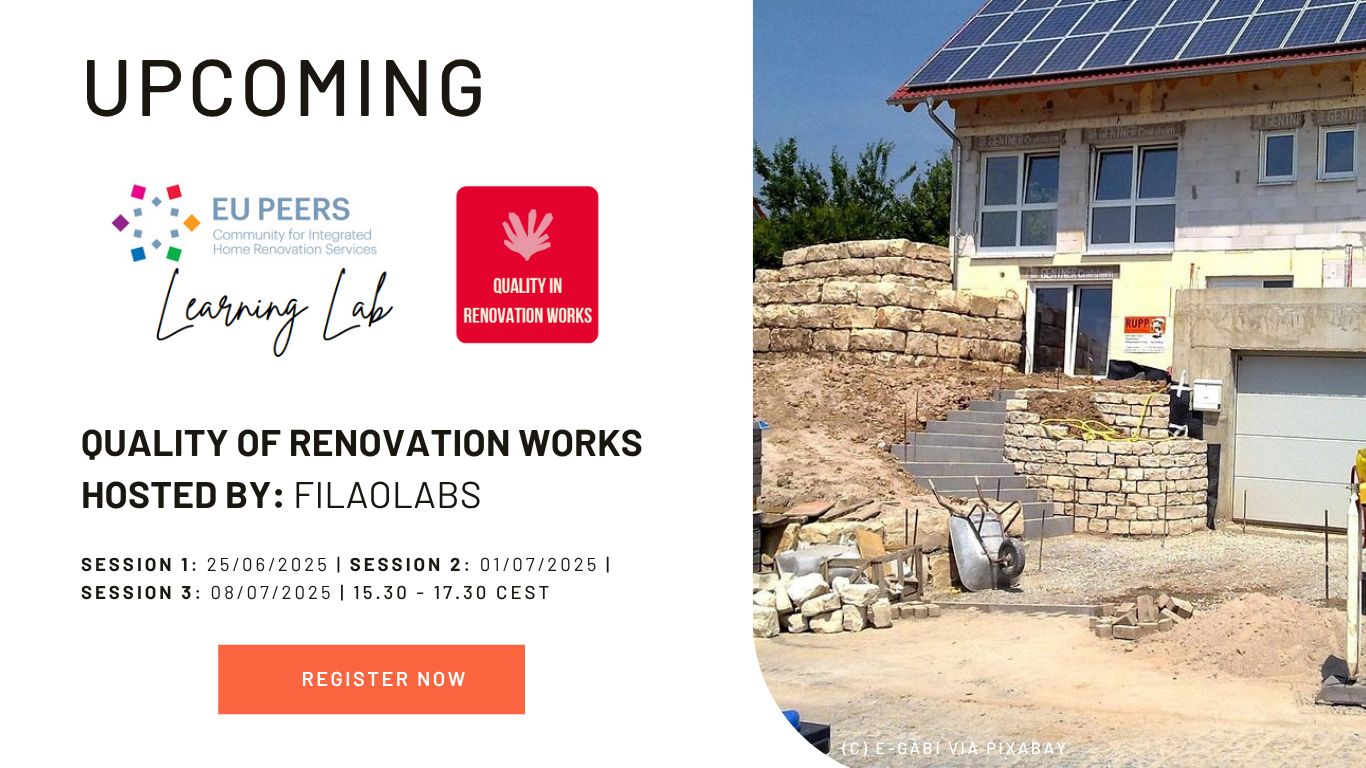
This session, led by Stéphanie Flacher (FilaoLabs) was centered on the impact of quality of work to ease the financing of the projects by the banks.



Join a community dedicated to advancing residential energy renovation in Europe
Join a community dedicated to advancing residential energy renovation in Europe
Register in our collaboration hub to empower yourself, expand your knowledge, connect with other organisations, and scale up the IHRS sector.
