

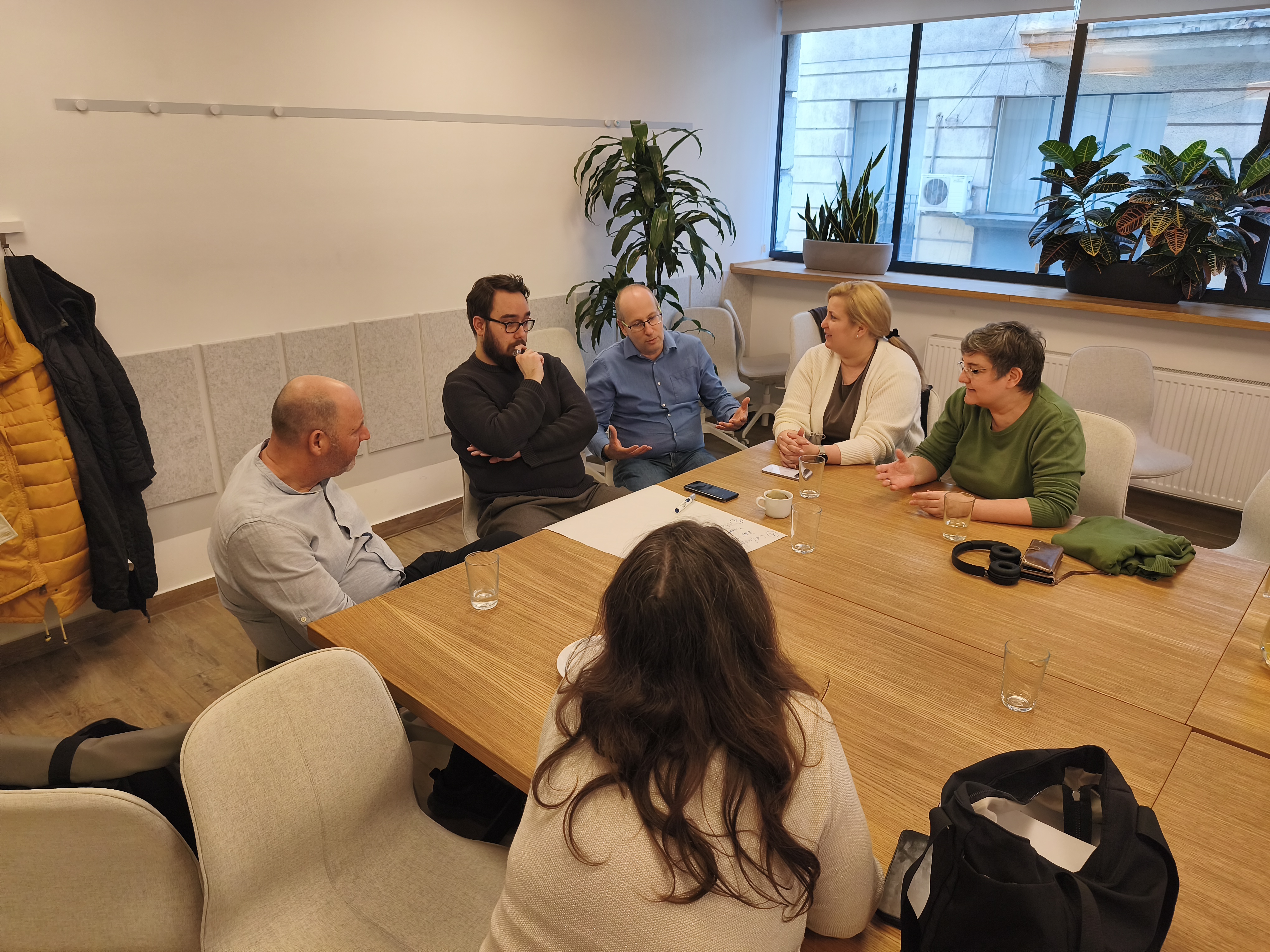
The 8th meeting of the Hungarian EU Peers community was held on 12 February 2026 in Budapest at the Contemporary Architecture Center, organised by Energiaklub Climate Policy Institute. It took place right after the MEHI conference on the implementation of the Energy Performance of Buildings Directive (EPBD) in Hungary. Twenty-two representatives from 20 organisations contributed to the success of the community meeting - we have never had so many people gathered together before.
Several people also participated in the morning event organised by MEHI, which was held to a full house. First, the lessons learned from the morning conference were discussed, followed by the introduction of the new community members: 14 people have joined the community of EU Peers since November 2025. The entry point to EU Peers for them was a training opportunity on one-stop shops for local governments organised in the frame of the community of practice that attracted more than 20 municipal and county governments applications. The participating organisations also joined the EU Peers community so that they could exchange experiences with market-player OSSs, the banking sector, and professional organisations. The largest energy provider in Hungary (MVM) also became a member of EU Peers.
After the introductions, Energiaklub presented its latest updates: the RenoPont website has been redesigned, offering a more customer-friendly approach and a more engaging presentation of technical, financial, and legal-administrative information related to building renovations. A new feature is that the RenoPont Home Renovation Center now recommends high-quality one-stop consultants and renovation companies on the website, where their names, contact details, professional qualifications,and references are included. The case studies showcase the most successful modernisation projects: EU Peers members are welcome to suggest further good examples for this section.
Another recent initiative is that, as part of the AHA project, the Hungarian Energy Efficiency Institute has published three handbooks on how to use energy more consciously: they help people living in residential buildings, panel buildings, and traditional apartment buildings with energy-saving tips, renovation advice, and examples of good practices. EU Peers members use their own contacts to help distribute the handbooks to joint representatives, condominium managers, and participants in the Budapest Green Panel Program.
Balázs Nattán, project manager at Budapesti Közművek, presented the latest developments in the Budapest Green Panel Program (BZP): the call for applications was announced in December and published in four districts (III,IX, X, XIII). In addition, a forum for joint representatives was heldin Kőbánya (District X.) where 30 joint representatives expressed interest in the program. The two-stage application process (first, condominiums apply to have the decision-making materials prepared, and then the most successful of these are implemented), the schedule, and the social aspects of the program were also discussed. If the per capita income of a resident in a condominium that has won a BZP is less than 300,000 HUF, they can apply to the Network Foundation for additional support - which covers up to 90% of the repayment installments related to the renovation. This ensures that even panel buildings where lower-income residents would not be able to cover the cost of modernization on their own can apply.
Since the EU Energy Performance of Buildings Directive stipulates that Member States must establish a national one-stop shop advisory network by 2026, the Hungarian community continued the discussion on what kind of one-stop shop renovation assistance would be considered effective and useful. We gathered arguments as to why such a network needs to receive public funding (independence, awareness raising, supporting energy poverty, etc.) and considered what other organisations could support OSSs providing freeadvice (municipal, county, and metropolitan governments). We discussed whether these advisory offices could be expected to generate their own income and what criteria should be used to evaluate and monitor them. Territorial coverage was also mentioned: the majority opinion was that it would be worthwhile to set up several offices in a county, but that one advisory point could serve several boroughs.
At the end of the meeting, the attention was drawn to the upcoming conference organised by MEHI and Energiaklub entitled "Good practices and obligations of local governments for climate-neutral buildings," (link to the event in Hungarian). It will include a meeting between one-stop advisors and the local governments participating in the event. We are confident that this event will convince more local governments to support the renovation of residential buildings in their communities through one-stop shop services.
Contact to the Hungarian EU Peers Community Manager
Image credits: MEHI

Related Articles
Insights into the EU Peers mentoring programme in Hungary: Helping municipalities turn renovation ambitions into action


Why cooperate with financial institutions?
Join a community dedicated to advancing residential energy renovation in Europe
Join a community dedicated to advancing residential energy renovation in Europe
Register in our collaboration hub to empower yourself, expand your knowledge, connect with other organisations, and scale up the IHRS sector.
