
Can you introduce yourself?
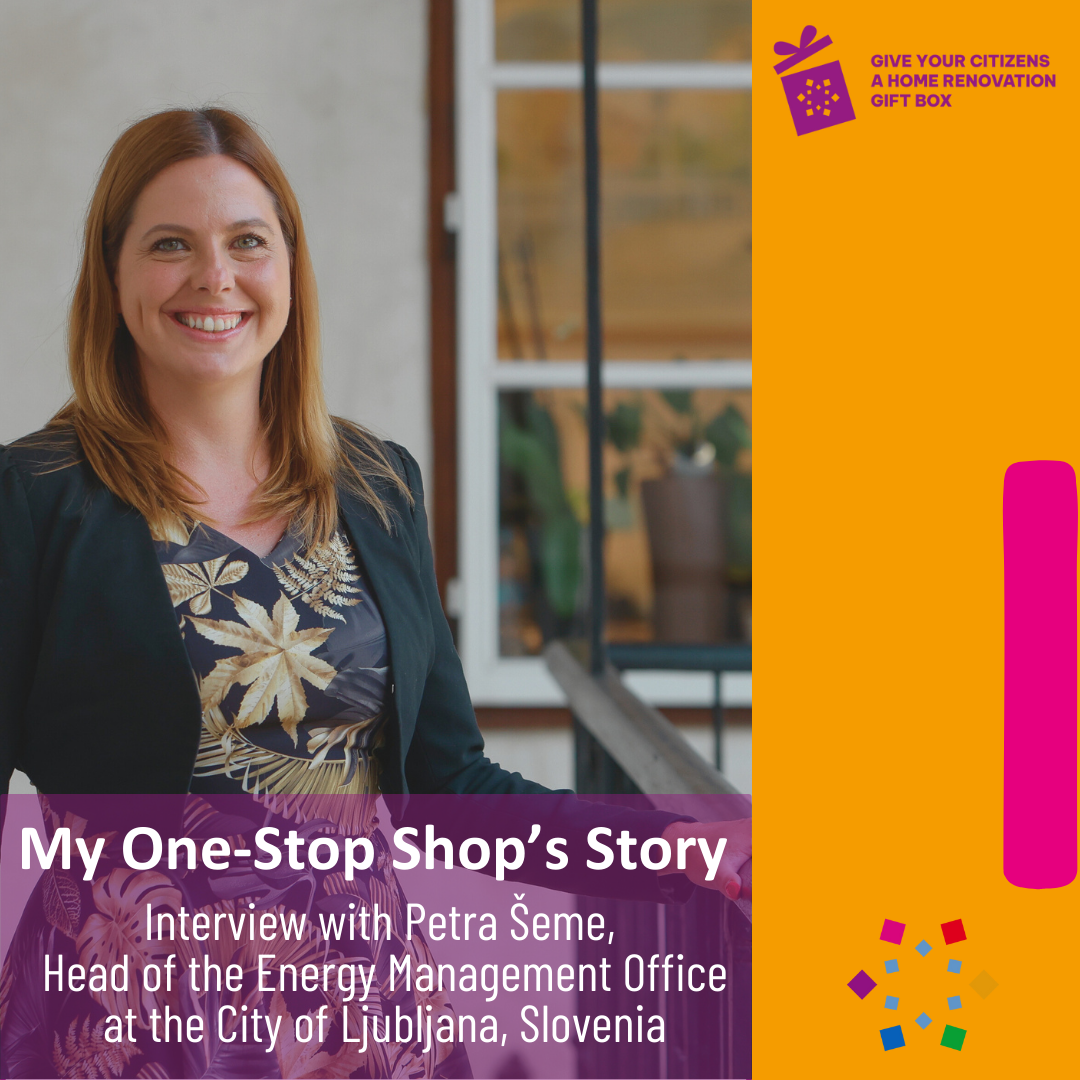
My name is Petra Šeme, and I serve as the Head of the Energy Management Office at the City of Ljubljana. I lead a dedicated municipal team that includes Milanka Ilić and Janja Bojanec, both of whom bring strong expertise in energy efficiency projects, particularly in the residential sector. We are a small but very committed team with strong hands-on experience in energy renovation projects.
It is important to understand that our office did not appear overnight. We started years ago with a single municipal energy manager. Over time, new EU and national obligations, but also very concrete needs from citizens, pushed us to grow into a dedicated municipal unit. Today, our role goes beyond monitoring and optimizing energy consumption and systems in our city. It is about helping people navigate extremely complex renovation decisions.
This broader mission is reflected in our involvement in the LIFE Renov-AID project , where the City of Ljubljana acts as a pilot city establishing a One-Stop Shop (OSS). Here, one of our main roles is coordination: connecting municipal services, national institutions, technical experts, researchers and advisors into an integrated approach that works for citizens in real life.
Can you present your organisation and the local context?
Ljubljana is a city of around 300,000 inhabitants, with a very clear political commitment: to become climate neutral by 2030. But this goal cannot be achieved through public buildings alone. Our real challenge lies in the residential building stock where more than 135,000 housing units are mostly privately owned, many of them built decades ago.
The data shows progress, but also the scale of the task ahead. Around half of residential buildings have renovated roofs, but far fewer have renovated façades or windows. Between 2009 and 2023, nearly 14,000 energy investments were co-financed through national Eco Fund grants. This tells us two things: people are interested, but they mostly renovate step by step, not comprehensively.
Multi-apartment buildings are an even bigger challenge. Ownership is fragmented, decision-making is slow, and trust is often fragile. Heating still relies heavily on gas and district heating, although we see rapid growth in renewables. In 2023 alone, Ljubljana counted over 1,800 self-supply solar systems. Citizens are starting to act but they need support.
That is why Ljubljana joined the EU H2020 Save the Homes project and later the LIFE Renov-AID project. We realised that subsidies alone are not enough. People need guidance, coordination, and reassurance along the home renovation journey especially when investments are large and long-term.
We also try to motivate through positive examples. Our “Naj blok” (“Best Building”) campaign celebrates good renovations and normalises ambition. The winning building is never a luxury showcase, it is a realistic example of what a well-managed renovation can achieve, technically and socially.
Tell us more about your One-Stop Shop
The One-Stop Shop (OSS) in Ljubljana was created because we kept hearing the same thing from citizens: “We want to renovate, but we don’t know where to start and we are afraid of making a mistake.”
For citizens, the OSS is a hybrid place where renovation becomes a clear guided process with experts along the way. We help people understand options, costs, financing, technical choices and administrative steps. The physical OSS office is located at the Mission 100 Info Point - in the attractive city centre, at the market place. People walk in because it feels like a public service, not a commercial showroom. Online, information is available through the city website and the national ENSVET platform. For deeper technical questions, we rely on trusted partners like the ZRMK Construction Institute.
As part of the Renov-AID project, we have also published a brochure which plays an important role here since it explains the Slovenian OSS concept in plain language and shows citizens that renovation is a journey with support at every step.

What is the role of the City in making the OSS work?
We believe that the OSS only works if the local ecosystem is involved and here the city acts as a facilitator. We are not the provider of technical services but we do ensure the high quality renovation services are visible to our citizens. At a practical level, Ljubljana provides accessible premises, co-finances activities, and ensures that municipal experts are actively involved. But the most important role is trust. When citizens see that the city takes renovation seriously, they are more willing to engage. Of course, we are actively renovating our own buildings as well. We also heavily invest in participation. People appreciate Mayor’s open-door days, citizen initiatives and neighbourhood events. This shows that such activities are important for gaining people's trust. Renovation decisions are emotional, financial and social. People need to be heard before they can commit.
OSS creation is a long journey. How is it going in practice?
We deliberately did not start from scratch since Slovenia already has a very strong ENSVET national network of energy advisors giving free energy advice, coordinated by the Eco Fund. This is a huge asset, even though citizens do not know it well, due to their low awareness and interest in energy renovations. Our goal is to build on ENSVET, strengthen its visibility, and expand its scope. That means, adding stronger technical support, better links to financing, and clearer guidance through the entire renovation process: from the first idea to the post-renovation use. This is where integration and local partnerships matter. ZRMK provides technical expertise and training, universities contribute with research and tools, municipalities test what works on the ground. The European LIFE Renov-AID project gives us the framework to connect these pieces. Homeowners themselves decide whether they choose local service providers but we try to empower them in taking decisions that work the best for them. We are also honest about the challenges since citizens are often sceptical, most often righteously so. They worry about costs, contractors, delays, and administrative complexity. We face a shortage of qualified advisors. Financing the OSS itself is an open question. But despite this, the process is motivating.
Our ambition is very clear. We believe that our OSS can become a successful permanent municipal infrastructure for renovation.
Do you have a message for other cities and for policymakers?
From our experience in Ljubljana, we see that renovations are often hindered due to complex renovation journeys. We need to create local ecosystems that lead to building trust. How do we do this? Through the coordination of currently mostly fragmented initiatives, local suppliers, financing, and technical actors along the renovation journey. Once they start more efficient collaborations, we can mobilize private investments into home renovations and create a stable continuity of energy renovations that lead to the decarbonization of our whole building stock.
To municipalities and regions we would recommend to:
- Start from what already exists and improve it.
- Give the OSS a real, visible place in the city.
- Invest in trust-building, not just information.
- Stay neutral towards contractors since credibility is everything.
- Treat renovation as a social process, not only a technical one.
- Plan long-term. Without stable financing and institutional anchoring, OSS remains fragile.
And for national and European policymakers we have these messages:
- Support OSS as a permanent public infrastructure, not only through short projects.
- Invest in digital tools that simplify renovation journeys and give information about (active) financing possibilities.
- Prioritise energy-poor households with tailored solutions.
- Encourage exchange between cities because peer learning works.
- Simplify regulatory frameworks where possible; complexity discourages action.
Discover why opening a One-Stop Shop for home energy renovation is your political win!
Join the EU Peers campaign and start building your One-Stop Shop now. Get inspiration and advice from more than 200 European One-Stop Shops and their supporters.

Related Articles

Impala Projects boosts home renovation in Canary Islands: “Our model is not only about business”
.png)
Monitoring the impact of OSS
Empower yourself by becoming a member of EU Peers Community of Practice!
Empower yourself by becoming a member of EU Peers Community of Practice!
Expand your knowledge, connect with other organisations, and scale up the sector of IHRS by joining the vibrant and evergrowing Community of Practice
