

Getafe’s One-Stop Shop: “The neighbourhood approach proved essential in reaching the heart of the residents.”
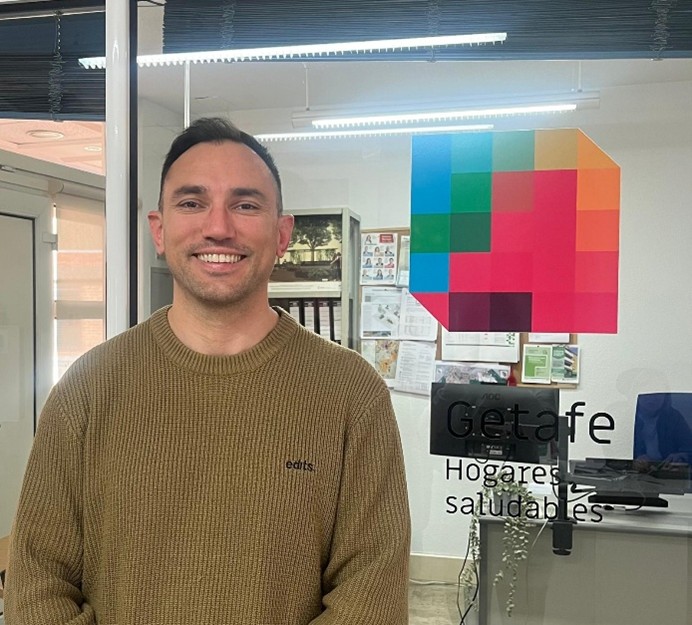
Interview with Pablo Hayali, Healthy Homes Department Coordinator and Social Worker at Getafe Municipal Land and Housing Company (EMSV Getafe)
About the initiative
- Can you introduce yourself?
My name is Pablo Hayali, I am a Healthy Homes Department Coordinator and Social Worker at Getafe Municipal Land and Housing Company (EMSV Getafe). My professional career has always been linked to the social sphere, particularly in the areas of housing and utilities, including housing exclusion.
- Can you present your organisation?
Getafe is a municipality of 189,000 inhabitants, located in the south of Madrid. Our municipal company has been working in the field of housing renovation for over 20 years. We manage municipal funds and programmes financed by the EU and other administrations. Every year, we distribute subsidies for building renovations, including grants for replacing windows, improving insulation, accessibility and building envelopes.
- Tell us about your One-Stop Shop
Our One-Stop Shop (OSS) opened its doors in January 2022 as part of the European programme Urban Innovative Actions - Energy Poverty Intelligence Unit - Healthy Homes Project. In September 2023, once the project was completed, the OSS was integrated into municipal services through the EMSV Getafe. The OSS employs five people: a general coordinator (architect), an office coordinator - social worker, and three administrative staff members. Our objective is to promote building renovation and to inform and accompany residents in their home renovation projects. We pay attention to the vulnerability of neighbourhoods and people, and we also work on issues related to energy supply, energy communities and self-consumption.
- What is the role of the city of Getafe in the creation of your One-Stop Shop?
The support from the municipal government was crucial for the development of the Healthy Homes project, and later, when European funding ended, for the structural integration of the OSS into the EMSV Getafe. The OSS was part of the municipality’s vision of the future of the city, along with the fight against energy poverty and data management.
- One-Stop Shop creation is a long journey, can you tell us how it went?
Thanks to our experience with programs such as the Area of Rehabilitation, Renovation and Urban Regeneration (ARRU), and with the Healthy Homes Office, we realised that the OSS is a key tool for providing support to citizens. Home energy renovation is a complex and unfamiliar topic. Our OSS brings it closer to citizens. Initially, we focused on energy poverty and utilities. Before we opened the OSS in January 2022, the OSS team had been conducting a series of visits and meetings with social workers in the municipality's neighbourhoods. Our aim was to understand their reality and needs, and to establish regular, trustful contact within the territory. The relationship with neighbourhood associations, organisations and other municipal departments was key for generating referrals and promoting the service. The OSS provides its services weekly in five neighbourhood Civic Centers spread across the municipality. One central office offers permanent support on utilities, energy renovation, energy communities, and shared self-consumption. The neighbourhood approach proved essential in reaching the ‘heart’ of the neighbourhoods and residents who use municipal facilities and services. We want the OSS to become a key player at three levels: home, building, and neighbourhood. We hope to mobilise homeowners' communities and to encourage renovation, especially at the building scale.
- What are your ambitions today?
We want to reach as many citizens as possible. Not only those in vulnerable situations but any resident or neighbourhood. However, we will also focus on what we identified as priority areas due to their building characteristics, socio-demographic profiles, and vulnerability. Thanks to the ‘Getafe Rehabilita’ strategy and the European City Facility programme, we have set our energy renovation priority areas and objectives and we know what effort it will take to achieve them. These are also included in Getafe's Urban Agenda. So far, our OSS has improved the accessibility and building envelopes of 12 buildings. We have refurbished and equipped with sensors over 50 homes and optimised energy utility services for some 3,000 families, saving them about €900,000 on utility bills. In the future, we want to collaborate with third sector entities who could provide products that our clients need – for example energy efficiency kits or photovoltaic installations.
- What would you do differently if you were setting up your One-Stop Shop today?
The OSS development is a truly positive experience. Since its opening, we have reached more than 1,300 families in just 20 months, and we are becoming an essential and structural service for citizens. The enthusiastic, committed team dedicated to public service and the recognition of the value of this service are key. If we were starting today, we would focus on contacting associations and third sector organisations, with the aim of reaching more people and promoting the service in a more targeted way. At the same time, we would develop more programmes for schools and colleges. Raising awareness on energy issues among young people is important.
- Do you have any message for your peers or for your national or European policy makers?
Before launching any new service, conduct a needs assessment and do it together with neighbourhood entities, residents' associations, and municipal departments. They will help you to design a service that reflects the territory’s needs. We have done it before opening Healthy Homes. The OSS team should ideally include people with cross-disciplinary training, with complementary technical profiles from both, social and construction and building sectors. Together, they are able to find integrated and realistic solutions for people. In our case, having a transdisciplinary team which has previously worked with neighbourhood associations and organisations, proved essential. The initial support of project partners such as Khora Urban Thinkers, the Polytechnic University of Madrid, the Construction Labour Foundation and the Association of Environmental Sciences was fundamental for the creation and training of our growing team.
More about the initiative
To learn more about the offerings, impacts, and the success of the project, you can download the written success case
Empower yourself by becoming a member of EU Peers Community of Practice!
Empower yourself by becoming a member of EU Peers Community of Practice!
