
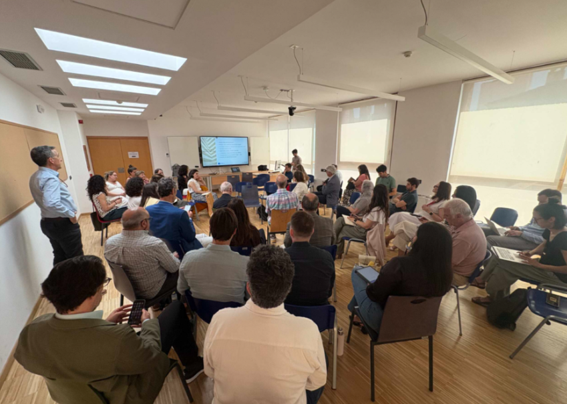
The twelfth meeting of the EU Peers community was held on June 10 within the framework of the Sostenibilidad XL event, organised by GBCE under the title "Affordability, innovation and competitiveness: trio of aces for sustainable building", in collaboration with the University of Alcalá.
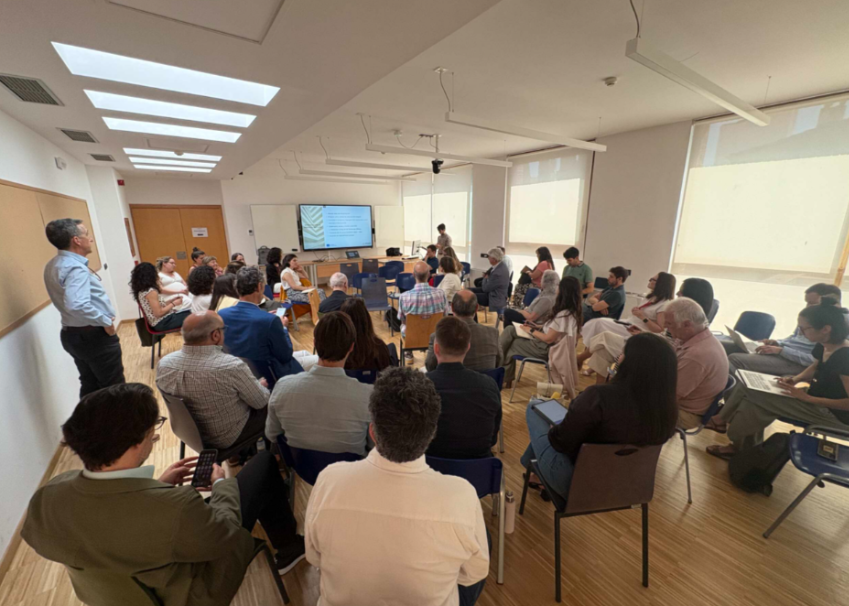
The meeting took place during the session How do Renovation Agents and OSS face the challenges of the National Building Renovation Plan?, in which several members of the community participated. The round table was attended by Rosario Vallejo (head of the Promotion Area of VVMM Bilbao), Paula Ferrando (Project Manager & Developer at GNE Finance), Olatz Ugarte (Basque Government) and Iván Madrigal (Director of Communication and Institutional Relations at EOS RenovAcción Profunda). The session was moderated by Miguel Segovia (Policy Coordinator at GBCE).
The session began by raising the challenge of decarbonising the built stock in Spain by 2050 and the need to transfer state policies to the local level. From this point, the debate was opened with the question of how to articulate governance that involves both the administration and the citizenry.
For their part, Olatz Ugarte and Txari Vallejo pointed out that, if the municipalities do not commit, the projects do not reach the citizens. They presented the model of the Management Commissions (Comisiones Gestoras), in which the Basque Government, the city council and neighbours representing the Communities of Owners participate to facilitate complex decision-making, such as the choice of the architect or the contractor. They also stressed that the role of the administration brings neutrality to the process, which generates confidence in the private sector.
From the perspective of the private sector, Iván Madrigal, from EOS RenovAcción Profunda, presented a business model based on four pillars: Integrated Home Renovation Services (IHRS), own financing with grace period, alliances between companies and energy savings guaranteed by contract. As he explained, the key to reaching the citizen is to simplify the offer through "two figures": compare the current energy expenditure of the neighbour with the total cost he will have after the renovation, adding the energy quota and the quota of the work.
Subsequently, Paula Ferrando, from GNE Finance, provided the financial and business model vision. She differentiated between the public one-stop shop, whose function is to offer neutral information, and the private renovation agent, which acts as an integrator of services. She pointed out that both figures are beginning to differentiate in the NBRP, although the regulation of the renovation agent is still pending. In addition, she identified the unfavourable Technical Inspection of Buildings (ITE) as the main driver driving communities to consider energy efficiency actions. She also referred to future financing models, such as "on-tax financing", through which the investment is advanced and later returned through municipal taxes. Finally, she analysed the distribution of costs, pointing out that private benefits must be assumed by the neighbours, while the actions on public space correspond to the administration.
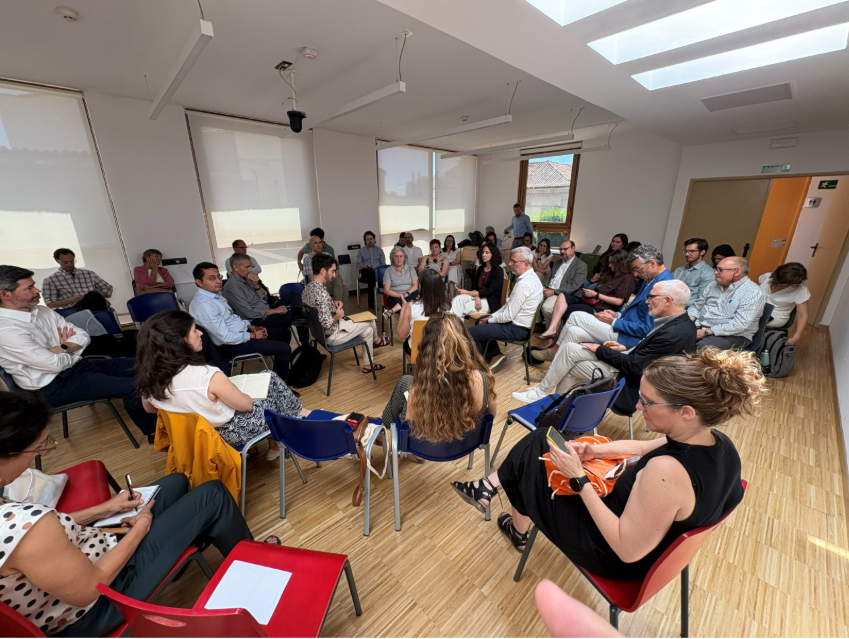
To close the session, Miguel Segovia, from GBCE, presented the results achieved during the first phase of the European EU Peers project on Integrated Home Renovation Services communities, which will end in September 2026, giving way to the second phase of the project, EU Peers II. During his speech, he stressed that, in the first three years, the community has managed to bring together nearly 90 entities in Spain and more than 600 entities throughout Europe. He also announced the continuity of the project until 2029, with the aim of expanding the network to 12 countries and reaching 1,000 members at the European level.

Related Articles

The Financial Challenge of Home Renovation


EU Peers Summit#2 2025: Powering the Future of One-Stop Shops in Europe
Join a community dedicated to advancing residential energy renovation in Europe
Join a community dedicated to advancing residential energy renovation in Europe
Register in our collaboration hub to empower yourself, expand your knowledge, connect with other organisations, and scale up the IHRS sector.
