
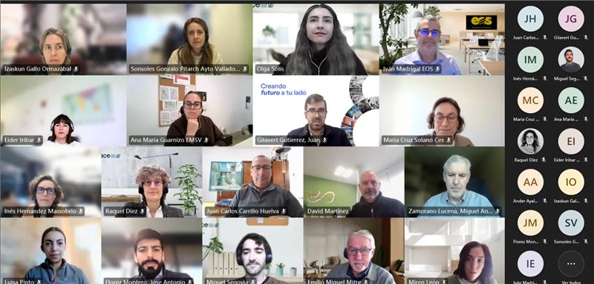
On 26 November 2025, the Spanish EU Peers Community held the last meeting of the year, in which a key aspect was discussed: how to guarantee the quality of work and maintain afterwork follow-up that allows the expected benefits to materialize in practice. This meeting brought to an end the series of four meetings in which we discussed all the phases of the rehabilitation process according to Millin & Bullier (2021).
During the meeting, tools and a success story of the community members were presented:
- Build Upon 2 Indicator Framework, developed by GBCE together with other European GBCs and cities. The framework establishes a methodology of comparable, interoperable and coherently organised data. This facilitates the monitoring of renovation at the building, district, or municipality scale in the three dimensions of sustainability: environmental, economic, and social. Aligned with data from National Building Renovation Plans (NBRPs) and Sustainable Energy and Climate Action Plans (SECAPs), some very useful data collection Excel sheets were presented for One-stop shop (OSS) and Renovation Agents. Presented by Raquel Diez of GBCE.
- GBCE QR quality certification, developed by the AIRE project. This third-party certified seal of quality guides one-stop shops (OSS) and owners through every step of the renovation, providing transparency, clarity and security to the process. This platform - currently in beta phase - centralises all the information so that the user can consult it at any time once validated by GBCE. Presented by María Cruz Solano from GNE Finance.
- Quality processes and keys to after-sales from Smart Community Service (Endesa), which showed the difficulty of transferring technical proposals to complex social contexts, where decision-making depends on multiple actors with different visions, priorities and levels of knowledge. Another fundamental point of his speech was the importance of after-sales maintenance: real efficiency is not only guaranteed by installing equipment, but by accompanying the user to ensure that the installation works as it should, that it is used correctly and that there is a clear structure of responsibilities. Presented by Juan Gilavert from Endesa.
After the presentations, there was a round of discussion in which more aspects were deepened.
Multifamily buildings: an ecosystem with its own rules
Convincing neighbours in collective buildings is a challenge. In addition, public subsidies in Spain, limited in time, have generated a lack of coordination between agents and the delay of work. Homeowners' associations require complete, clear projects with all the necessary information from the beginning: costs, fees, financing, subsidies and benefits.
The turnkey model and the comprehensive warranty
Some members of the Community are ‘renovation agents’ (IHRS) who offer a comprehensive service that ranges from document management to the execution of the work.
A single contract facilitates responsibilities, improves quality and provides security to the user, with a relationship that can extend beyond the construction site and continue with the maintenance of the building.
Conclusions
The 9th meeting of EU Peers Spain made a central idea clear: quality in renovation does not depend only on the work, but on the entire ecosystem that supports it.
The three speakers agreed that it is essential to:
- provide a structure of clear methodologies for data collection;
- professionalise traceability and processes through quality platforms;
- strengthen pedagogy and communication with homeowners' associations;
- assume after-sales as an essential, and not optional, part of the process.
This session showed that progress towards deeper and more effective renovation requires coordination, shared systems, and a long-term sectoral culture. The interest of members in participating in demos, providing feedback and collaborating across territories reinforces the position of the EU Peers Community as a key space to build that shared vision.

Related Articles

Strengthening the one-stop shop Community in Italy

.jpg)
The European Community for Integrated Home Renovation Services: officially launched at the EU Peers Summit on 11 June in Brussels
Empower yourself by becoming a member of EU Peers Community of Practice!
Empower yourself by becoming a member of EU Peers Community of Practice!
Expand your knowledge, connect with other organisations, and scale up the sector of IHRS by joining the vibrant and evergrowing Community of Practice
