
Thirty of the more than seventy member entities of the EU Peers Community in Spain met on the 3rd of November for their eighth meeting, which focused on how to finance housing renovation. This event is part of a series of four meetings in which the community shares experiences and lessons learned about the entire residential renovation process.
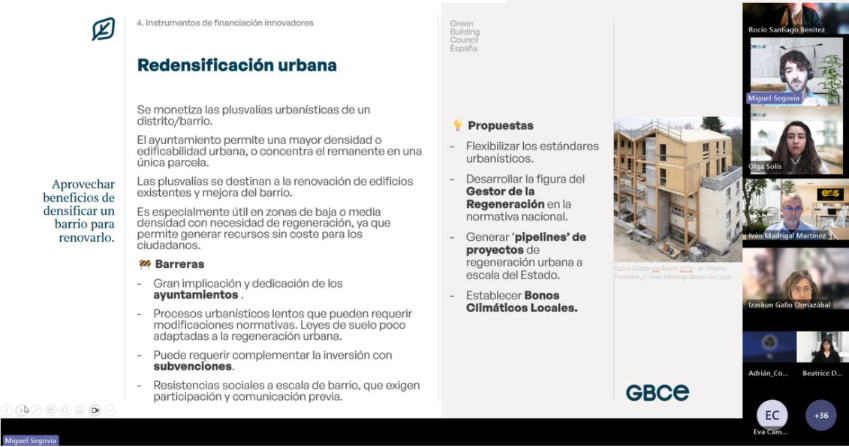
Before getting into the main topic, Miguel Segovia (GBCE) presented the different financing instruments for building renovation, based on the results of the participatory process for the National Building Renovation Plan, in which GBCE had the opportunity to moderate various groups. Of the eighteen instruments identified, he highlighted seven: four that are scalable, i.e. already widespread in the market and with the potential to continue expanding - such as unsecured loans, grants, White Certificates and tax incentives - and three that are innovative, including Property Linked Finance, urban redensification and crowdfunding.
After that, two members of the community shared their experiences and projects.
UCI – Unión de Créditos Inmobiliarios:
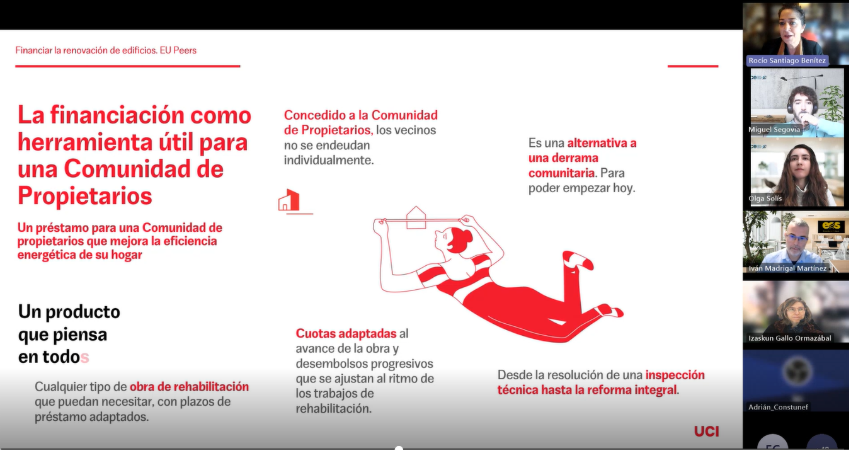
Rocío Santiago, commercial director of residential renovation at UCI, highlighted the role of financial institutions in facilitating energy renovation as an alternative to additional charges. She explained that UCI accompanies homeowners' associations throughout the process - from identifying needs to signing the loan - with products tailored to the progress of the work and their ability to pay. To this end, its loans establish a franchise that allows disbursements to be adjusted throughout the renovation process. Its model allows projects to be undertaken without initial capital.
EOS RenovAcción:
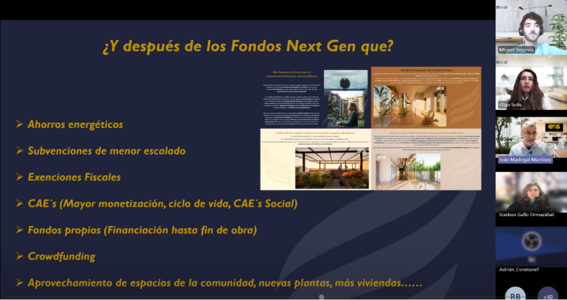
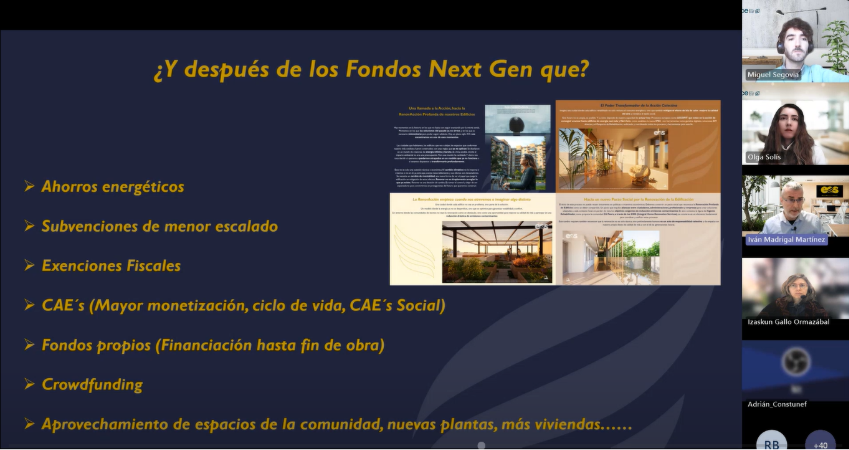
Iván Madrigal, director of communication and international relations at EOS, presented the ESCO (Energy Service Company) model, in which financing is based on the savings generated by the renovation. EOS combines engineering, construction, grant management and its own finance company, offering work without initial payment or complex procedures. He highlighted that integrating financing into the contract speeds up decisions and pointed to new types of financing, such as the monetisation of the White Certificates, crowdfunding and the financing of energy communities.
The debate following the presentations generated a very enriching exchange between members of the community, which allowed for an in-depth discussion of several key issues regarding the current challenges and opportunities in financing renovation and urban regeneration.
Public-private partnership: key to reaching the most vulnerable neighbourhoods
It was highlighted that urban regeneration projects only achieve sustainable results when there is genuine collaboration between financial institutions, public administrations, technical experts and renovation companies. Several participants emphasised that the most successful experiences, such as those developed in neighbourhoods in Madrid and Catalonia, were achieved thanks to this public-private cooperation, especially in contexts where social vulnerability requires closer and more coordinated management.
Urban re-densification and use of buildable land
One of the most debated topics was the potential of urban re-densification - expanding buildable land or concentrating surplus land on a single plot - as a way to finance renovation. It was noted that, although this strategy can generate capital gains that help to finance neighbourhood renovation, it faces significant regulatory barriers, especially those arising from the Horizontal Property Law, which requires unanimity when modifying the building's title deed, and urban planning regulations. It was proposed to explore regulatory changes that would facilitate this type of operation, pointing out its great capacity to mobilise investment without relying on public subsidies.
White certificates and their role in financing
White Certificates were also discussed as a financing instrument, with agreement that their implementation in the residential sector remains limited. Challenges were raised, such as the low monetisation of passive measures (envelope) and the need to ensure that a portion of these certificates benefits vulnerable households. In addition, formulas were discussed to monetise them more quickly and integrate them into energy contracts or Energy Service Company (ESCO) models, thus avoiding tax problems and simplifying management for communities.
ICO-MIVAU guarantees and uncertainty about their continuity
Several participants expressed concern about the future of the ICO-MIVAU line, which ends in December 2026 along with the Next Generation funds. There was agreement that this tool has been one of the most effective mechanisms for facilitating access to credit for renovation projects, both for banks and for homeowners' associations. However, they warned of the risk of losing this financial leverage if its continuity is not ensured in future state programmes.
New financing models: flexibility and anticipation
Finally, the need to move towards more flexible financial models was addressed, allowing money to be available from the start of the works without depending on the arrival of subsidies. The importance of building trust among homeowners' associations through payment plans tailored to the progress of the works and the financial capacity of the residents was highlighted. Likewise, the culture of partnerships between renovation agents, financial institutions and administrations was valued as an essential element in accelerating the pace of building renovation.
Conclusions
Overall, the debate reflected a consensus on the need to innovate in the way renovation is financed and to adapt the regulatory and financial framework to the reality of the projects. The EU Peers community thus reaffirmed its role as a space for collective learning and for promoting more sustainable, inclusive and economically viable renovation models.
Finally, attendees were reminded of the ninth and final meeting of the year for the community in Spain:


Related Articles

Join the EU Peers Study Visits: Strengthen your OSS capabilities across Europe

The Financial Challenge of Home Renovation
Join a community dedicated to advancing residential energy renovation in Europe
Join a community dedicated to advancing residential energy renovation in Europe
Register in our collaboration hub to empower yourself, expand your knowledge, connect with other organisations, and scale up the IHRS sector.
