

Who is Who - EMSV Getafe
How a municipal housing company in Getafe combines energy poverty support, renovation advice and energy communities in one public one-stop shop.
About the initiative
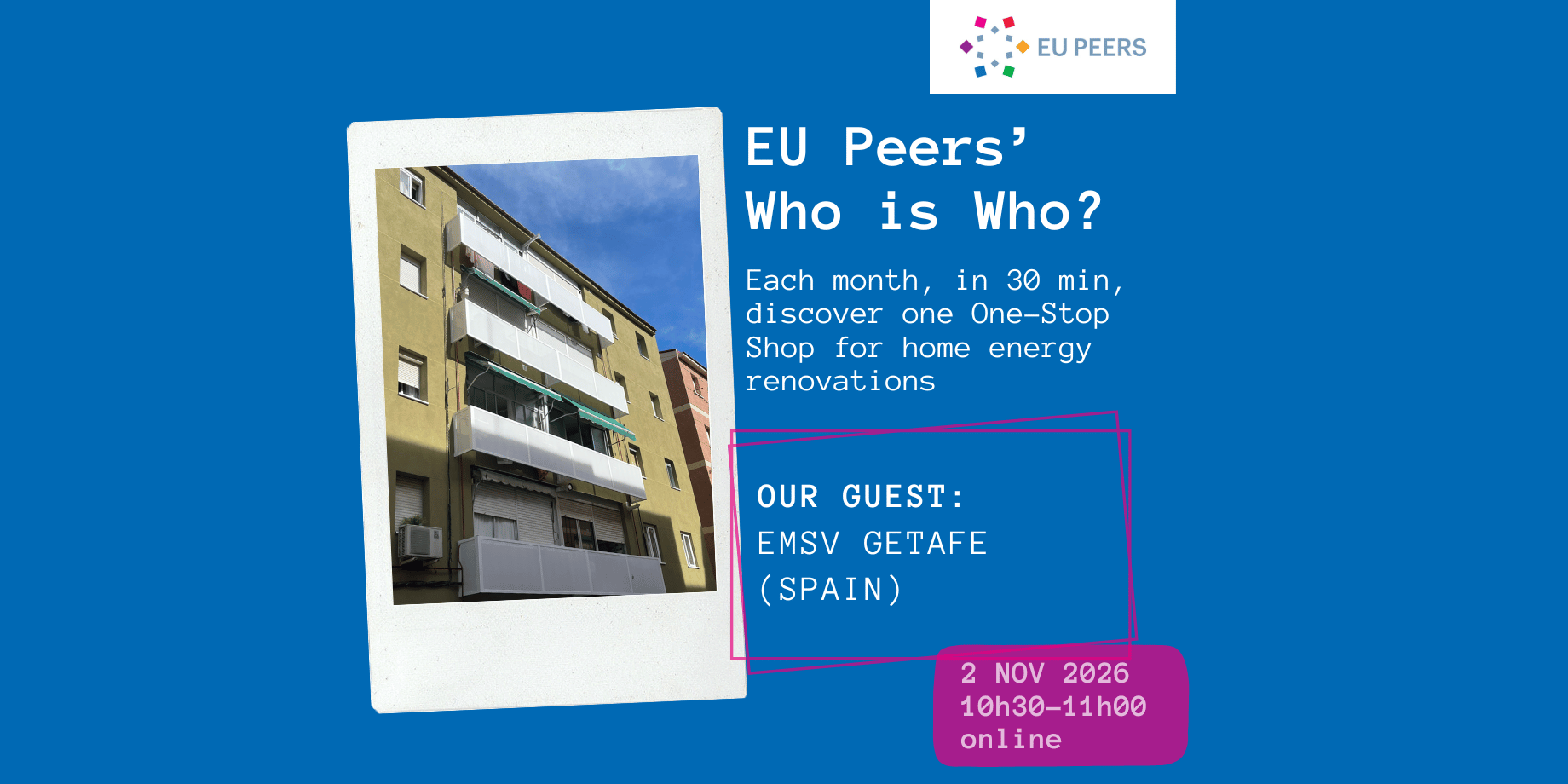
Who is Who is an EU Peers series of 30-minute online sessions in which one one-stop shop for home energy renovation presents its model and its team.
Discover the Integrated Energy One-Stop Shop run by the Municipal Land and Housing Company of Getafe (Madrid, Spain).
This integrated public One-Stop Shop (OSS) combines three complementary services: the Healthy Homes Office, addressing energy poverty, energy savings and household comfort; the Renovation Office, supporting homeowners and residential communities throughout building renovation processes; and the Community Transformation Office, facilitating renewable self-consumption, energy communities and citizen participation.
Their main strength is the integration of social, technical and community-based approaches, supporting residents from their initial energy needs to more complex renovation and collective energy projects. Through personalised advice, neighbourhood outreach and cooperation with local organisations, the OSS reaches vulnerable households and helps overcome financial, administrative and organisational barriers.
Speaker: Marta Acosta Plata, Coordinator of the Community Transformation Office, EMSV Getafe
Who are you and what does your organisation do?
The Municipal Land and Housing Company of Getafe (Empresa Municipal del Suelo y la Vivienda de Getafe, EMSV) is a public company, 100% owned by the municipality. Our motto is guaranteeing the right to energy and housing: there is no right to housing without the right to energy, because a home with insufficient energy supply or poor energy performance is not a proper home to live in.
What is the local context in Getafe?
Getafe is a municipality of about 200,000 inhabitants, 15 km south of the centre of Madrid. Several neighbourhoods were built very quickly in the late 1960s, with low energy performance standards, to house people moving from rural Spain to the towns around Madrid. These buildings have aged badly and today house a large share of vulnerable and energy-poor households. Lower incomes make renovation harder, and higher energy bills make it harder still to start.
Many residents are elderly. When they move to care homes or to their families, they often rent their flats out, increasingly to migrant tenants, who have no say over renovation because they are not the owners. At the same time, Getafe has Sector III, one of the largest single-family housing areas in Europe, and new neighbourhoods of high-performance multi-family buildings.
How is the One-Stop Shop organised?
EMSV runs a One-Stop Shop for energy services made up of three offices, each working at a different scale: the Healthy Homes Office targets the household, the Renovation Office the homeowners' association and the building, and the Community Transformation Office the neighbourhood and the community at large. A second municipal company, Getafe Iniciativas, works on energy communities in the industrial areas.
What does the Healthy Homes Office do?
The office originated in the European project Energy Poverty Intelligence Unit (EPIU), which ran from 2019 to 2023. When the project ended, it became a permanent municipal service, funded by the municipality and housed at EMSV. Its services include:
- Energy bill optimisation and advice on choosing suppliers and between the regulated and the free market.
- Education on energy habits and energy efficiency.
- Advice on the social bonus (bono social), which gives discounts on electricity, gas and water bills.
- Support during supply cuts and negotiations with suppliers, for clients who are often elderly, migrants or have low digital literacy.
- Express home interventions with the Red Cross, such as replacing heating systems, appliances or windows.
- Research with a local university, using sensors in households to detect hidden energy poverty and prevent it.
Besides its headquarters, the office runs nine itinerant offices in different neighbourhoods every week.
What does the Renovation Office do?
The Renovation Office manages renovation subsidies, including NextGenerationEU funds in recent years and national housing funds from now on. It assesses applications for Getafe's municipal subsidies, advises residents during renovation, and runs workshops in the target neighbourhoods on the need to renovate and the financial instruments available.
What does the Community Transformation Office do?
The office opened in February 2024 under a national programme of the Institute for the Diversification and Saving of Energy (IDAE), funded by NextGenerationEU. The programme ended in late 2025, and EMSV has made the office a permanent municipal service. It informs residents, raises awareness, and accompanies energy community projects through all their stages, acting as facilitator with other actors, including the municipality. It focuses on renewable self-consumption, citizen energy and energy communities.
Why a one-stop shop inside a one-stop shop?
Setting up or joining an energy community requires administrative, legal, technical and social knowledge that no single person has. Top-down projects work but are slow and miss the chance to empower citizens; bottom-up groups face many barriers alone. According to 2025 data, Spain has more than 837 energy communities, but only 26% have a project under way. Getafe takes a hybrid approach: the office sparks interest and then works back and forth with residents on the most practical solution.
What are the benefits of this approach?
- Proximity and trust, with weekly workshops and street campaigns in a different neighbourhood.
- Tailor-made solutions: municipal installations at key sites whose energy is shared through an energy community with energy-poor households, who join as full members.
- Simpler processes, since one place gives advice on the home, the building and the neighbourhood.
- An intermediary role with the municipality, where knowledge of energy communities is often lacking.
- Easier financing: banks see projects supported by a public entity as low-risk.
- Empowerment: members of the energy community now run workshops for their peers, for example on collective energy purchasing.
How does community energy connect back to home renovation?
The energy community works with the Red Cross: 30% of the energy generated by any of its projects will go to energy-poor households, which take part in decision-making as full members. The community was also selected by the Energy Communities Facility; its approved plan capitalises its energy project to create a solidarity revolving fund that helps vulnerable households in Getafe tackle energy poverty and renovate their homes.
What comes next?
EMSV is a partner in a LIFE project launched in September that helps other cities and countries set up similar one-stop shops.
More about the initiative
Learn more about the offerings, impacts, and the success of the project!
Subscribe to the EU Peers Newsletter
Subscribe to the EU Peers Newsletter
