
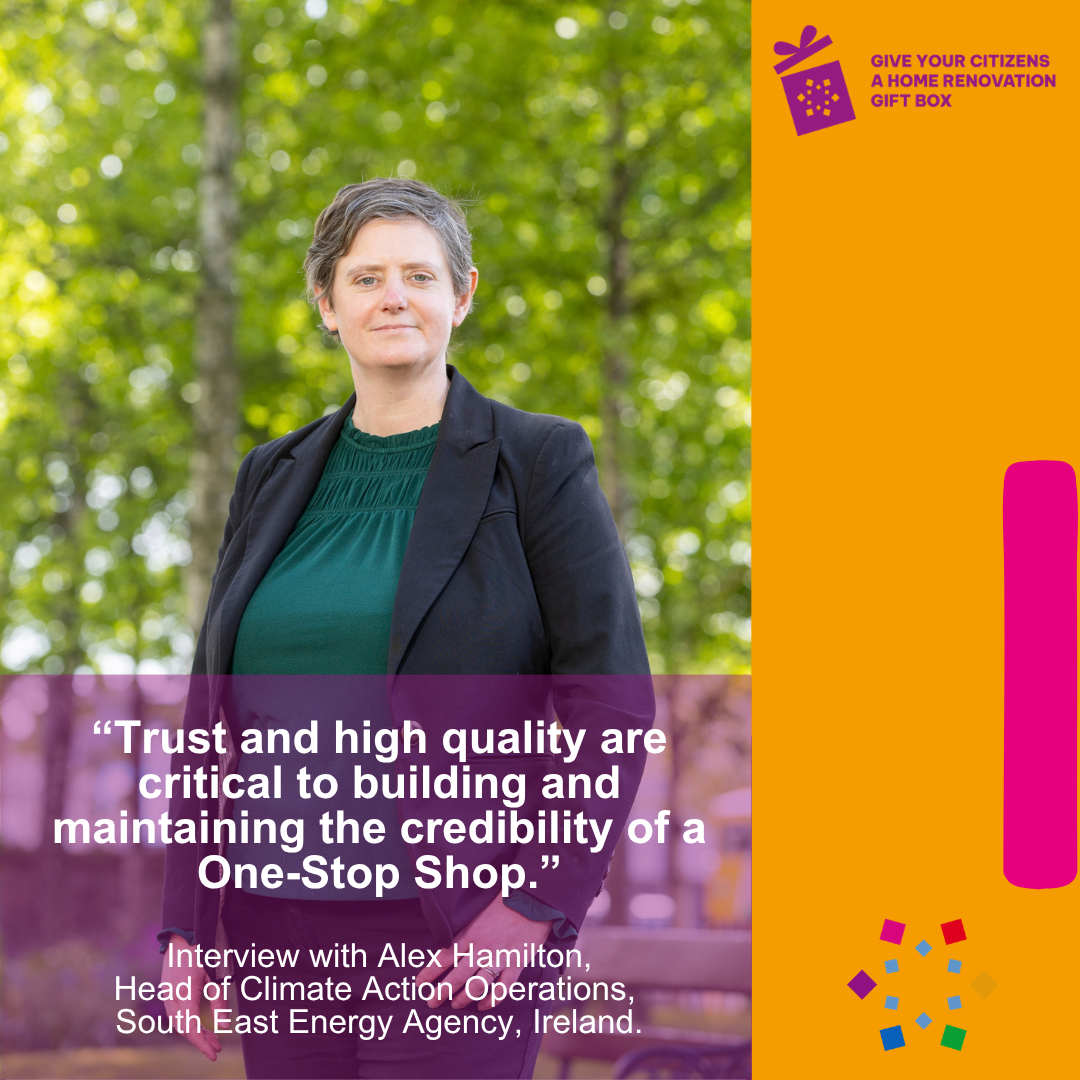
Trust and high quality are critical to building and maintaining the credibility of an OSS
Can you introduce yourself?
Alex Hamilton, Head of Climate Action Operations, South East Energy Agency, Ireland. The Energy Agency was established in 2002. We developed our in-house domestic retrofit programme between 2013 and 2017, based on national programmes and grants from the Sustainable Energy Authority of Ireland (SEAI), with our full one-stop shop (OSS) development being designed following the SEAI’s National Deep Retrofit Programme. As Senior Engineer at the time, I would have established the Agencies processes and quality checks for our OSS.
Can you present your organisation?
The South East Energy Agency (SEEA) acts as the regional OSS for four counties in partnership with the four local authorities of Kilkenny, Carlow, Wexford and Waterford. These four counties represent approximately 8.9% of the national population. SEEA supports households across the region to improve their energy performance whilst addressing the challenges of energy poverty. We contribute to Europe’s target of a zero-emission building stock by 2050. In 2025, we delivered 13 residential energy upgrades, through SEAI fundingschemes. The Agency also delivers free energy clinics where members of the public receive personalized, one-to-one advice from an energy expert. An Energy Clinic is where we hold an open-door event for the public to come and receive one-to-one advice on their own individual homes, and get support if needed to complete some of the paperwork required to move to the next steps of the journey. 15-minute appointment slots are set up for people to book, usually following a general presentation on the grants and OSS supports available.
Tell us more about your One-Stop-Shop
The South East Energy Agency was established in 2002, with the first foray into OSS partnership with local contractors, homeowners and financiers taking place in 2013 with energy upgrades being completed on over 1000 homes between 2013 and 2019 under various national grant funding programmes. The Energy Agency has operated as an OSS with a mix of core funding from our Local Authority partners, EU funding under various projects and commercial fees charged for project management. The team has grown and restructured a number of times over the years, and the Agency now has 36 FTE across all of its teams. Those specifically relating to the domestic OSS include marketing & communications, community liaison officers, technical engineers and finance officers. The OSS was set up to increase the number of domestic retrofits and specifically to work with and upskill local contractors to deliver high quality energy upgrades.
What is the role of the local authorities in the creation of your One-Stop Shop?
The four Local Authorities we partner with provide funding to the Agency to deliver a number of supports across its own energy management obligations and to support all citizens across the region. The Local Authorities set out an annualwork plan that includes support to fuel poor and vulnerable home owners and increasingenergy awareness. The fact that they are involved allows us to act as the independent and trusted intermediary on their behalf. Citizens know who the Local Authorities are and their role, so the direct link with them allows us toprovide these supports and advice services to the citizens in an already trusted forum.
One-Stop Shop creation is a long journey, can you tell us how it went?
It has indeed been a long journey – from one or two team members to an Agency soon to reach 40 FTE.
The challenges have varied from working with poor quality contractors, the time it takes to complete the home energy upgrade journey, the cost of works and a national grant programme that has changedits terms and conditions almost constantly over the last 13 years.
Consistency in delivery is key to earn trustfrom homeowners and other stakeholders. The difficulty as an energy agency is that our role is to upskill local contractors and encourage them to become their own OSS. However, this then can make it more difficult to find contractors who want to partner with us long term. Usually, 2-3 years is how long we work with contractors before they are sufficient to go and deliver the works independently from us. So we have to begin a cycle again of creating new partners and upskilling them in the upgrade works. From a commercial point of view this creates more competition – as an energy agency we need to balance the commercial work we do that is needed to fund the non-commercial element (support andadvice) of the OSS.
Due to the lack of contractors, and the looming and ambitious national targets Ireland is working towards, supply and demand, as well as inflation, have caused a massive increase in the cost of energy upgrades. In 2017, the average cost of upgrades to A rated homes was €37k with 50% grant funding. In 2025 we saw the average price increase to over €80k with €20k (25%) grant funding. This is a significant change in less than 10 years, and we have seen the number of home energy upgrades completed year-on-year decline over this period, for various reasons, but cost certainly plays a part.
The time it takes from initial enquiry to completing a home energy assessment, to procuring the works and confirming prices can be considerable, and homeowners can either lose interest, circumstances change or prices increase in that period, which means we seea significant drop off in homeowners who come for advice and support, to those who complete a home energy assessment and then those who go ahead to complete the works.
Similarly, in terms of grant drawdown, it can take up to 9 months post works before the grant is paid back for the project. This is a long time for either homeowners or OSS to cashflow an average of €20k per home, and therefore limits the number of homes that can be taken on at anyone time. As mentioned above in relation to costs – the national grant programme to support home energy upgrades has also changed significantly overthe years, and also year-on-year we have found that the terms & conditions of the project can change annually.
This makes it very hard for an OSS to establish itself and maintain consistency in delivery. One small example is a domestic Building Energy Rating (BER) certificate that lasts 10-years. However, in 2025 the grant programme stated that a BER for grant purposes needs to be published within 2-years of the programme – again due to more stringent regulation by the national authority in recent years. This has resulted in extra work for the OSS and extra cost for the homeowner.
What are your current ambitions?
The thing we are most proud of is restructuringour team and processes to ensure consistency across the OSS journey. We are ISO90001 certified since 2022, and have 100% pass rate for all homes completed through the national grants programmes. We have helped establish three other OSS in the region and have advised many others nationally. The team has grown considerably, and the aim is to grow from delivering 13 homes in 2025 and 35 homes in 2026 to 100 homes in 2027. These are small numbers nationally, however our objective is to increase the number of contractors operating in theSouth East region.
What would you do differently if you were setting up a One-Stop Shop today?
SEEA has a fantastic record when it comes toOSS but it has been challenging when it comes to procurement of contractors to deliver the works. We feel that value for money may be an issue for homeowners as there is not a competitive tendering process for the actual renovation works when using a commercial OSS – once an OSS has been chosen, the final price ofthe works is not known until the homeowner is already on the journey with that chosen OSS.
In our OSS as we are the independent advisor, we can establish what works are required and then procure competitively in the market. Between 2019 and 2020, we developed our Dynamic Purchasing System (DPS) for this purpose, to ensure a framework of competitive and competent qualified contractors were available. However, over the years we have found that the DPS is not fit-for-purpose and we are in the process of updating it. I’m not sure at this stage, could we have done this differently, or did we need to do it this way to learn from it and improve it? Procurement is a key phase of the OSS process and this needs to be done right to help with the value for money aspect, quality of works in terms of competent contractors, as well as ease for the OSS in procuring the works.
Setting up an OSS is fraught with challenges no matter how prepared you can be. Essentially, it is important to define what the objectives of the OSS are and what it needs to achieve. This has to be considered in the context of what CAN be achieved.
I think everything we have done has taught us a lesson, either positive or negative, and we have used these learnings to grow and develop. Our ISO90001 process is one of continual improvement, so we learn and improve as we go along.
Do you have any message for your peers or for your national or European policy makers?
Definitely talk to other OSS and get advice– depending on the commercial nature of this, it is easier for some more than others. See what models exist and if they can be applied to your region. The customer journey can be long and complicated, trust and high quality are critical to building and maintaining the credibility of an OSS. Delivering 10 high quality home energy upgrades are better than 50 poor quality upgrades. Get the basics right, then scale up.
In terms of policy support, if you are using national funded programmes to support the OSS delivery, then it is critical to have a consistent approach from national agencies – constant changes do not help anyone.
Would you like to say anything else?
Good Luck!

Related Articles


The New EPBD: A New Standard for a More Sustainable Future

Empower yourself by becoming a member of EU Peers Community of Practice!
Empower yourself by becoming a member of EU Peers Community of Practice!
Expand your knowledge, connect with other organisations, and scale up the sector of IHRS by joining the vibrant and evergrowing Community of Practice
